About
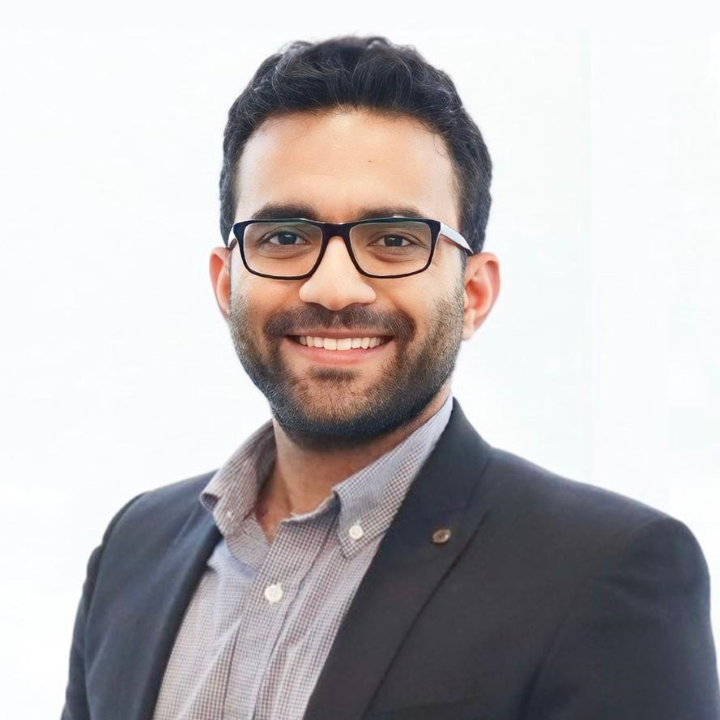
I am a Ph.D. in Mechanical Engineering from Georgia Institute of Technology and recently a Research Scientist Intern at Meta Reality Labs Research. With over 10 years of experience spanning academia and industry, I specialize in ultrasound system development, from multi-channel transducer array design and beamforming optimization to GPU-accelerated wave propagation simulation and real-time signal processing. My work bridges nonlinear acoustics in heterogeneous media with practical wearable sensing and medical ultrasound therapy applications, combining rigorous computational modeling with hands-on hardware prototyping and embedded DSP.
Current Research
At Meta Reality Labs Research, I developed next-generation wearable ultrasound sensing technologies for AR/VR systems, working on compact transducer arrays for strain imaging, building real-time signal processing pipelines, and implementing Doppler-based motion rejection algorithms for robust sensing in dynamic environments. My doctoral research at Georgia Tech investigated transcranial focused ultrasound therapy using lensed as well as phased array based ultrasound systems, where I developed GPU-accelerated aberration correction algorithms, optimized acoustic hologram topologies through heterogeneous skull bone, and volumetric trasn-skull passive acoustic mapping and image reconstruction.
Research Areas
Wearable Ultrasound Sensing
Designing and prototyping wearable ultrasound transducer arrays for AR/VR platforms. Expertise in multi-channel system optimization, beamforming parameter tuning, Doppler-based motion rejection, and SVD-based clutter filtering for high-sensitivity physiological monitoring.
Transcranial Ultrasound Therapy
Developing acoustic hologram-based systems for non-invasive brain therapy. Implementing heterogeneous angular spectrum approaches for skull aberration correction, beamforming sequence optimization, and parametric array techniques for trans-skull monitoring.
Signal & Image Processing
SVD-based spatiotemporal filtering, strain imaging and elastography, Doppler flow processing, advanced beamforming (delay-and-sum, angular spectrum), and ultrafast high-frame-rate acquisition for transient event capture and volumetric image reconstruction.
Vibroacoustic Modeling & NVH
Experimental modal analysis, structural noise transfer path quantification, and active noise control with embedded DSP. Industry experience in powertrain NVH optimization, psychoacoustic tuning, and real-time adaptive filtering (FxLMS) on TMS320 platforms.
Professional Journey
Research Scientist Intern, Meta Reality Labs Research
May 2025 – Nov 2025
Developed and ehanced ultrasonic sensing modalitties for robotic and AR/VR platforms. Key contributions include:
- Beamforming parameter tuning and multi-channel ultrasound imaging system performance benchmarking
- Doppler-based motion rejection algorithms for robust wearable sensing
- SVD-based signal filtering for clutter suppression and SNR enhancement
- Cross-functional collaboration with hardware, firmware, and algorithm teams
Graduate Research Assistant, Georgia Tech
2020 – 2025
Ph.D. research in transcranial focused ultrasound therapy and neuromodulation biophysics. Key achievements:
- GPU-accelerated nonlinear wave propagation simulations for heterogeneous skull bone
- Fast aberration correction algorithms using differentiable acoustic propagators and Verasonics arrays
- Acoustic hologram topology optimization for improved spatial targeting and image reconstruction
- Ultrafast acquisition for capturing transient neural responses in neuromodulation studies
Graduate Research Assistant, Virginia Tech
2018 – 2020
M.S. research in vibroacoustic modeling and structural dynamics in the Vibration and Acoustics Laboratory. Key contributions:
- Experimental modal analysis of rolling tires using laser vibrometry and accelerometer arrays for structure-borne noise prediction
- Quantified structural noise and vibration transfer paths under realistic operating conditions
- Designed a semi-active tuned absorber to reduce rest tremors in Parkinson's patients
Senior Design Engineer, Bajaj Auto Ltd.
2015 – 2018
Led powertrain NVH optimization and active noise control system development with 3+ years of industry experience:
- Embedded DSP implementation (TMS320) for real-time active noise cancellation
- FxLMS adaptive filtering achieving 10 dB attenuation in engine intake noise
- End-to-end hardware prototyping, testing, and product validation
- Psychoacoustic tuning and pass-by-noise regulatory compliance
Technical Expertise
Ultrasound Systems
Multi-channel array systems (Verasonics) • Beamforming & sequence optimization • Transducer characterization • Aberration correction • Passive acoustic mapping • Ultrafast imaging
Signal & Image Processing
SVD-based spatiotemporal filtering • Strain imaging / elastography • Doppler processing & motion rejection • Digital Image Correlation (DIC) • Adaptive filtering (FxLMS)
Simulation & Analysis
GPU-accelerated nonlinear wave propagation • FEM (COMSOL, Ansys, HyperMesh) • Multiphysics modeling • MATLAB/Simulink
Programming & Hardware
Python • MATLAB • C/C++ (embedded DSP & hardware) • Simulink • Sensor prototyping • Signal acquisition (ADC/DAC) • CAD (SolidWorks, Siemens NX)
Vibroacoustic Modeling
Experimental modal analysis • Laser vibrometry • Structure-borne noise prediction • Noise transfer path analysis • Active Noise Control (ANC) • Psychoacoustic tuning • NVH optimization
Scientific Machine Learning
Data-driven acoustic modeling • Differentiable physics simulators • Machine vision • Imaging with learned models • Optimization techniques • Model order reduction
Research Philosophy
My research philosophy centers on bridging fundamental wave physics with practical engineering solutions. Whether developing wearable ultrasound sensors or advancing non-invasive brain therapies, I combine rigorous experimentation with high-fidelity computational modeling to tackle complex challenges. My interdisciplinary background — spanning nonlinear acoustics, multi-channel array systems, embedded DSP, and signal processing — enables me to approach problems end-to-end, from transducer design through algorithm development to system validation. I believe the most impactful research emerges at the intersection of disciplines, and I thrive in collaborative environments that bring together academic researchers and industry partners.
Let's Connect